

G-Protein Coupled Receptors Market to Reach US$ 6.1 Bn by 2033 | Persistence Market Research
G-Protein Coupled Receptors Market
Market driven by rising chronic diseases, advanced drug discovery, and growing focus on targeted therapies, with innovation shaping future growth and demand
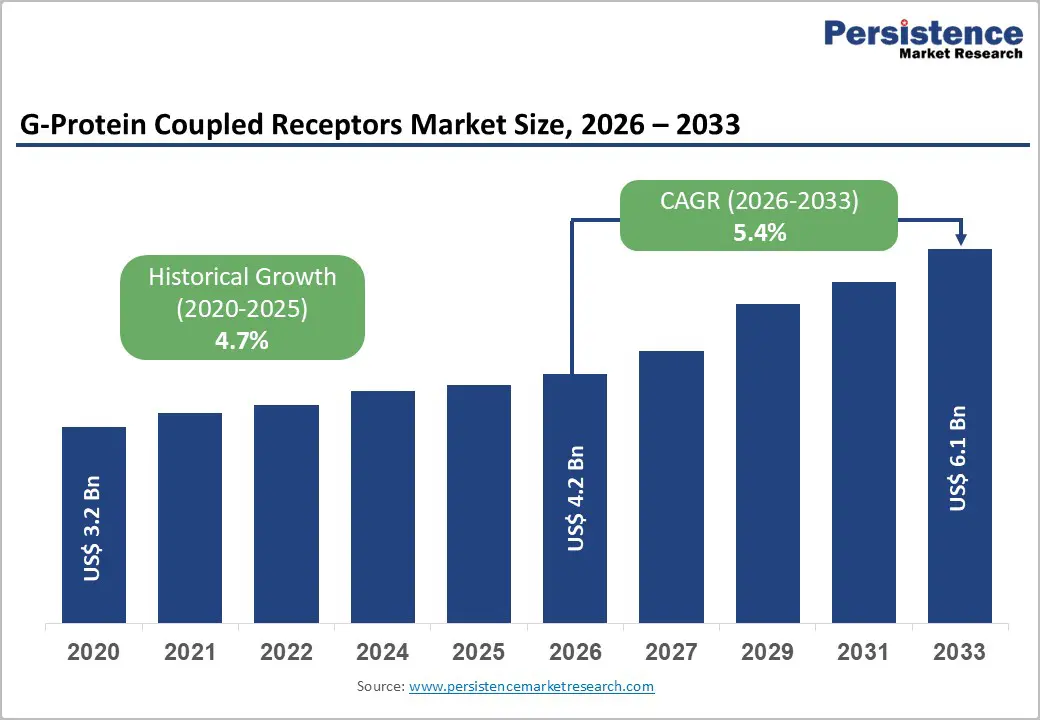
LONDON, UNITED KINGDOM, March 31, 2026 /EINPresswire.com/ -- The global G-Protein coupled receptors market size is expected to be valued at US$ 4.2 billion in 2026 and projected to reach US$ 6.1 billion by 2033, growing at a CAGR of 5.4% between 2026 and 2033. The market growth is being propelled by multiple converging factors that are reshaping the pharmaceutical landscape.
Market Drivers and Trends
Increasing prevalence of chronic diseases such as cancer, cardiovascular disorders, and neurological conditions is a major driver for the G-Protein coupled receptors market. These receptors play a crucial role in cell signaling and are widely targeted in drug discovery and development. Pharmaceutical companies are heavily investing in GPCR research due to their involvement in a wide range of physiological processes.
Additionally, advancements in biotechnology and molecular biology have significantly enhanced the understanding of receptor structures and functions. This has led to the development of more selective and effective drugs targeting GPCRs. The integration of artificial intelligence and computational modeling in drug discovery is further accelerating market growth.
Download Your Free Sample & Explore Key Insights: https://www.persistencemarketresearch.com/samples/33950
Challenges and Restraints
Despite promising growth, the market faces several challenges. High costs associated with drug discovery and development pose a significant barrier for new entrants. Additionally, the complexity of GPCR signaling pathways often leads to difficulties in identifying precise drug targets. Regulatory hurdles and lengthy approval processes can also delay product launches and impact overall market expansion.
Opportunities and Future Outlook
The growing focus on personalized medicine presents significant opportunities for the G-Protein coupled receptors market. Advances in genomics and proteomics are enabling the development of targeted therapies tailored to individual patient profiles. This approach improves treatment efficacy and reduces adverse effects, thereby increasing patient compliance.
Emerging markets in Asia-Pacific and Latin America are also expected to offer lucrative growth opportunities due to rising healthcare expenditure and improving research infrastructure. Collaborations between academic institutions and pharmaceutical companies are further fostering innovation in GPCR research.
Get Custom Insights Designed for Your Businecss: https://www.persistencemarketresearch.com/request-customization/33950
Market Segmentation
Based on product type, the market can be segmented into cell lines, detection kits, ligands, and others. Among these, cell lines hold a significant share due to their extensive use in receptor research and drug screening. In terms of application, the market is categorized into cancer, cardiovascular diseases, central nervous system disorders, and others. The cancer segment dominates owing to the high demand for targeted therapies.
Regional Insights
North America holds the largest share of the global G-Protein coupled receptors market, driven by advanced healthcare infrastructure, strong presence of leading pharmaceutical companies, and substantial investment in research and development. Europe follows closely, supported by increasing government funding and growing focus on innovative therapies.
The Asia-Pacific region is anticipated to witness the fastest growth during the forecast period, attributed to expanding pharmaceutical industry, rising awareness about advanced treatments, and increasing clinical trial activities.
Competitive Landscape
The G-Protein coupled receptors market is highly competitive, with key players focusing on strategic initiatives such as mergers, acquisitions, partnerships, and product launches. Companies are also investing in research and development to introduce novel therapies and maintain their market position.
Checkout Now & Download Complete Market Report: https://www.persistencemarketresearch.com/checkout/33950
Market Segmentation
By Product
Cell Lines
Detection Kits
Cell Culture Reagents
Ligands
By Assay Type
cAMP Functional Assays
Calcium Functional Assays
β-Arrestin Functional Assays
Radioligand Binding & GTPγS Functional Assays
Internalization Assays
Trafficking Assays
Others
By Application
Cancer Research
CNS Research
Metabolic Research
Cardiovascular Research
Respiratory Research
Inflammation Research
Others
By Regions
North America
Europe
East Asia
South Asia & Oceania
Latin America
Middle East & Africa
Conclusion
In conclusion, the global G-Protein coupled receptors market is poised for steady growth over the coming years. The increasing prevalence of chronic diseases, technological advancements, and rising demand for targeted therapies are key factors driving market expansion. While challenges such as high costs and regulatory complexities persist, ongoing innovation and expanding applications are expected to create new opportunities for market players.
Furthermore, continued exploration of GPCR biology and signaling mechanisms will unlock new therapeutic avenues across multiple disease areas. Increased collaboration between industry stakeholders and academic researchers is likely to accelerate the translation of scientific discoveries into commercially viable products. As healthcare systems worldwide emphasize precision medicine and improved patient outcomes, the demand for GPCR targeted drugs will continue to rise steadily, reinforcing the long-term growth trajectory of this market globally. Sustained investment in innovation, supportive policies, and expanding pipelines will further strengthen market dynamics in the coming decade.
Read Related Reports:
Toxoplasmosis Testing Market: The global toxoplasmosis testing market will rise from US$ 2.4 billion in 2026 to US$ 3.5 billion by 2033, growing at a 5.8% CAGR over the forecast period.
Ineffective Esophageal Motility Treatment Market: Global ineffective esophageal motility treatment market will grow from US$4.6 Bn in 2026 to US$6.9 Bn by 2033, driven by rising GERD and advanced diagnostics.
Persistence Market Research
Persistence Market Research Pvt Ltd
+1 646-878-6329
email us here
Visit us on social media:
LinkedIn
Instagram
Facebook
YouTube
X
Legal Disclaimer:
EIN Presswire provides this news content "as is" without warranty of any kind. We do not accept any responsibility or liability for the accuracy, content, images, videos, licenses, completeness, legality, or reliability of the information contained in this article. If you have any complaints or copyright issues related to this article, kindly contact the author above.
